Vibe-coded Photoshop is a trap
Build what people want, don't copy what they settled for
I’ve been writing software for almost 30 years, starting as a teenager building websites for small businesses in the late 1990s. Between 1995 and 2005, I must have spent thousands of hours in Adobe Photoshop. But when I booted it up again recently, I hit a wall. Even with my prior experience, the current interface feels cluttered and confusing.
I went looking for a simpler, and let’s face it, cheaper alternative and tried them all —- from the open-source giants to the web-based knockoffs. None of them felt right. So, for the last six months I’ve spent all my free time building my own, which I have named DepthField Photo. This post is about why it’s not just another clone.
There is a distinct temptation when building design software to just make it look like the industry standard. It saves you from having to design a user interface, it makes your marketing easier, and it gives new users a false sense of familiarity.
But it’s a trap. A Photoshop clone is built from the outside in. It copies every decision Photoshop is stuck with, but captures none of the engineering, the ecosystem, or the decades of industry trust that make Photoshop the standard.
We have entered the era of Screenshot Software. A developer can vibe-code a UI in a few weeks that looks identical to a professional suite. But taking a visual cutting of an application and sticking it in a new codebase is like taking a cutting from a mature plant and sticking it in dirt. It looks like the real thing on the surface, but there is no root system to keep it stable or sustain it over time.
Here is what happens when your acceptance test is a screenshot.
They copied the wrong answer
Ask a random 25-year-old Etsy seller or content creator what an “Unsharp Mask” does. They don’t know, and the intuitive guess – “makes things unsharp” – is the opposite of what it actually does. Ask them if “Black & White” is an adjustment or a filter. Again, how should they know? The image editors of yesterday weren’t designed for them, and it shows.
Photoshop 1.0 shipped in 1990. It has a 35-year legacy of technical debt, naming conventions borrowed from 1995 darkroom photography, and obsolete tools that Adobe physically cannot remove because thousands of legacy actions and corporate presets depend on them. Screenshot Software copies this baggage without questioning it. It replicates the six different long-since-obsolete selection tools, the nested menus, and the archaic naming conventions because the developer assumes that this clutter is what makes the app “professional”. The clone inherits all the friction of the original, with none of the historical reasons for why that friction exists.
The invisible work that matters
What a visual cutting does not replicate is the invisible engineering beneath the canvas. The robustness, the ability to handle high resolution images. The “just works” experience. Anyone who uses computers knows the frustration of losing your work to an application that didn’t autosave, an accidental deletion which couldn’t be undone, or simply a crash before you could hit save. Nobody wants an app that randomly loses their work – even if it’s free.
A user interface is easy. Managing 50-megapixel raster files in memory without stuttering, building bulletproof crash recovery, and handling thousands of edge cases – that is the actual product. To earn user trust, you have to provide a stable footing for them to stand on. Free clones rarely have the funding or the focus to maintain that invisible foundation. As operating systems update and hardware architectures shift, Screenshot Software rots. The buttons still look like Photoshop, but the engine of trust just isn’t there.
Adobe’s monopoly-grade moat
Finally, Screenshot Software entirely ignores the ecosystem and the legal boundaries surrounding the original app.
If a professional truly needs Photoshop, they rarely just need Photoshop. They need Illustrator, Lightroom, After Effects, InDesign, and Creative Cloud. They rely on thousands of third-party plugins, actions, and presets. Even if a clone attempts to support all of those file types, it cannot replicate the community or the industry trust Adobe has spent decades building. It is a gigantic moat, and to Adobe’s credit, much of it well-earned.
Affinity proved this moat can be attacked. But when Canva acquired Affinity and made it free, they established a brutal new yardstick for any Photoshop alternative. The latest crop of me-too clones comes up painfully short in that comparison. If you are building outside the Adobe moat today, the smart move isn’t to copy what Affinity already provides for free. It is to offer an entirely different experience, like a flatter learning curve or strong generative AI integration.
More importantly, there are hard legal boundaries to what you can copy. Take Content-Aware Scaling. I have been obsessed with the seam carving algorithm since it was first presented by Shai Avidan and Ariel Shamir at ACM SIGGRAPH 2007, almost twenty years ago. I remember how Adobe licensed it at the time and made it a signature feature of the next version of Photoshop, so I knew the technique was likely under patent. So rather than blindly implementing it in DepthField Photo, I took the time to dig up the original Mitsubishi Electric patents. And because I am building a real product and don’t particularly want to get sued, I am postponing Content-Aware scaling in DepthField until 2027, when that patent finally expires. Screenshot Software developers, especially the full-tilt vibe coding kind, run the risk of moving too fast to check who owns the tools they are replicating or the model weights they are bundling.
Am I just yelling at clouds?
As I find myself criticizing the influx of Photoshop clones, I hear a few predictable objections.
“But (Photoshop alternative) is free and it works fine”
In software, “free” always carries the risk of a rugpull, abandonment, or data sale unless it is funded some other way. The economic reality of maintaining large, multi-platform applications requires deep pockets, even with agentic coding. When you don’t pay for the software, you can’t expect to be the priority.
“You build with AI agents too, so aren’t you just vibe coding too?”
Of course I use AI agents. The difference is that DepthField Photo is designed from first principles, not chained to a 35 year old Photoshop-shaped brick. It is one editor (raster) on exactly one platform (Apple Silicon). The test surface is small by design. It is built for stability and performance first, so your 50 MP files actually work and your data survives a crash. I am choosing quality over compatibility, and charging a $69 one-time fee so I can keep making that choice.
“A paid app from one developer is a riskier bet than a free one from another”
It is a risk. I am a solo developer with no outside funding, after all. But I am building the tool I actually want to use, without the pressure to appease a board of directors or inflate user metrics for an acquisition. A standalone desktop application that you own, and which will keep running on your machine even if all the DepthField servers go dark. And once the beta period ends (at the end of October 2026), you can download the free trial and decide for yourself.
Built from first principles, not copied
Photoshop is a powerful tool, but it isn’t intuitive for casual users. We just all collectively accepted it because, for a few decades, the alternatives were awful, and you couldn’t simply build your own image editor. Now that agent-assisted coding is becoming viable for larger projects, you can – so I did.
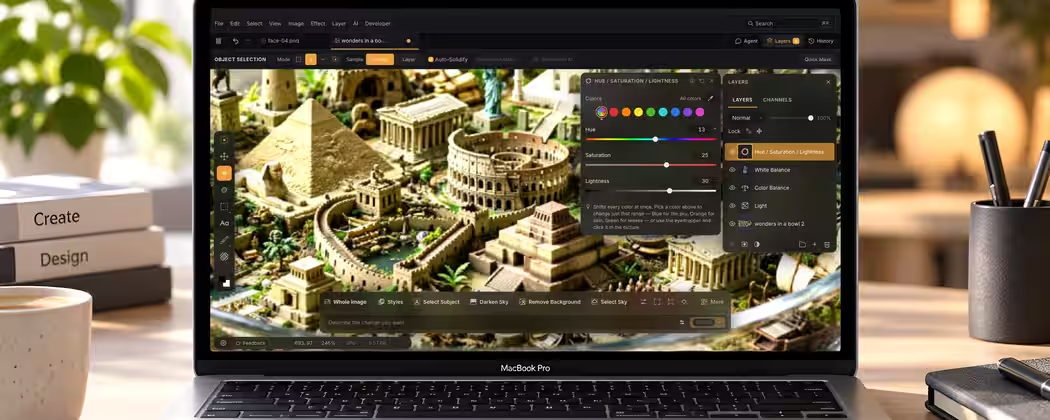
In DepthField Photo, the tool that sharpens your image is called “Sharpen”. The tool that blurs your image is called “Blur”. You don’t have to guess if Black & White is an adjustment or a filter, because everything is a live filter. You don’t have to begin every session by creating a Smart Object, because every operation is non-destructive by design. And you don’t have to contort yourself to find and use generative AI features, because the interface is designed with them front and center.
That is what happens when you step back and consider what users actually need, and which legacy features are truly worth keeping. You get to build an application for the people who need it today, not for a darkroom photographer in 1995.
Now sure, I’m biased. I am trying to sell a product, and I have to believe there is a demand for an image editor beyond “just copy Photoshop”. And maybe there isn’t, or maybe my pricing is wrong, or maybe my approach to UI is flawed. But let me know what you think. Go sign up for the free beta of DepthField Photo on depthfield.photo and see what a photo editor could look like if you designed it from scratch in 2026.
In a world where software can be whatever you need it to be, don’t settle for a copy.